
New Paper: What Happens When an LLM Enters an Actual Planning Process?


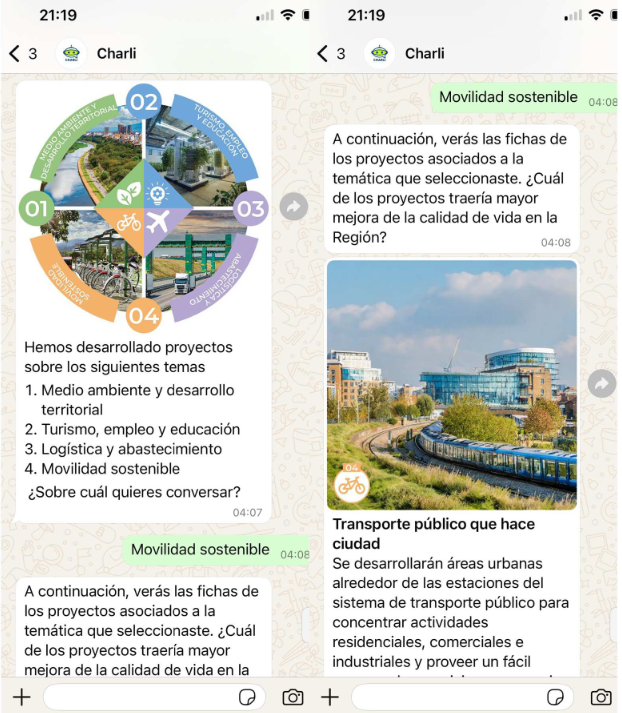
Our new paper, “Automating Consultation? Urban Planners and Chatbot-Based AI-Mediated Participation,” has just been published in the Journal of Urban Technology (Jonathan Dortheimer, Ariel University; Michelle L. Oren; and Aaron Sprecher, Technion). This research excites us because it goes beyond the usual discussion of what LLMs could do for public participation — we studied what happened when an LLM chatbot was actually deployed as part of a regional strategic planning process.
Over two years, we followed two deployments of a WhatsApp-based chatbot in the Sabana Occidente region of Bogotá, Colombia. Citizens used it for visioning, exploring projects, and voting, resulting in 273 citizen–AI interactions. Drawing on semi-structured interviews with the planners who ran the process, we looked at their expectations, experiences, and the criteria they used to judge whether it was working. The results showed the chatbot reduced barriers to participation, expanded access, and helped prioritize projects — so yes, there is real potential here for AI to broaden participation.
The gap: we found a striking difference between what the technology could enable and how planners chose to use it. The planners positioned the chatbot as a tool for consultation and data collection, not deliberation. Concerns about misinformation and the limited depth of AI-mediated deliberation made them cautious about giving the system a more substantive role.
This leads to the paper’s central finding: the democratic value of AI in planning is not determined by the chatbot itself — it is determined by the governance arrangements around it.
That raises questions that may matter more than the sophistication of the underlying LLM:
- Who validates the information?
- Who is accountable for summarizing what citizens said?
- Can participants trace how their input was interpreted?
- Does participation actually influence the planning decision?
Why it matters: the first generation of AI participation tools may primarily help planners listen to more people. The much harder challenge is developing systems that can help citizens understand trade-offs, deliberate with one another, and meaningfully influence planning decisions — without handing democratic authority over to an algorithm. That is a very different proposition, and it deserves much more empirical research in real planning processes, rather than only prototypes and experiments.
Read the full paper: https://doi.org/10.1080/10630732.2026.2693907