


2026
Publication
METROPOLIS: Urban Digital Twin
An open, interoperable urban digital twin framework for integrating city data, deploying urban AI models, and supporting evidence-based planning.
About
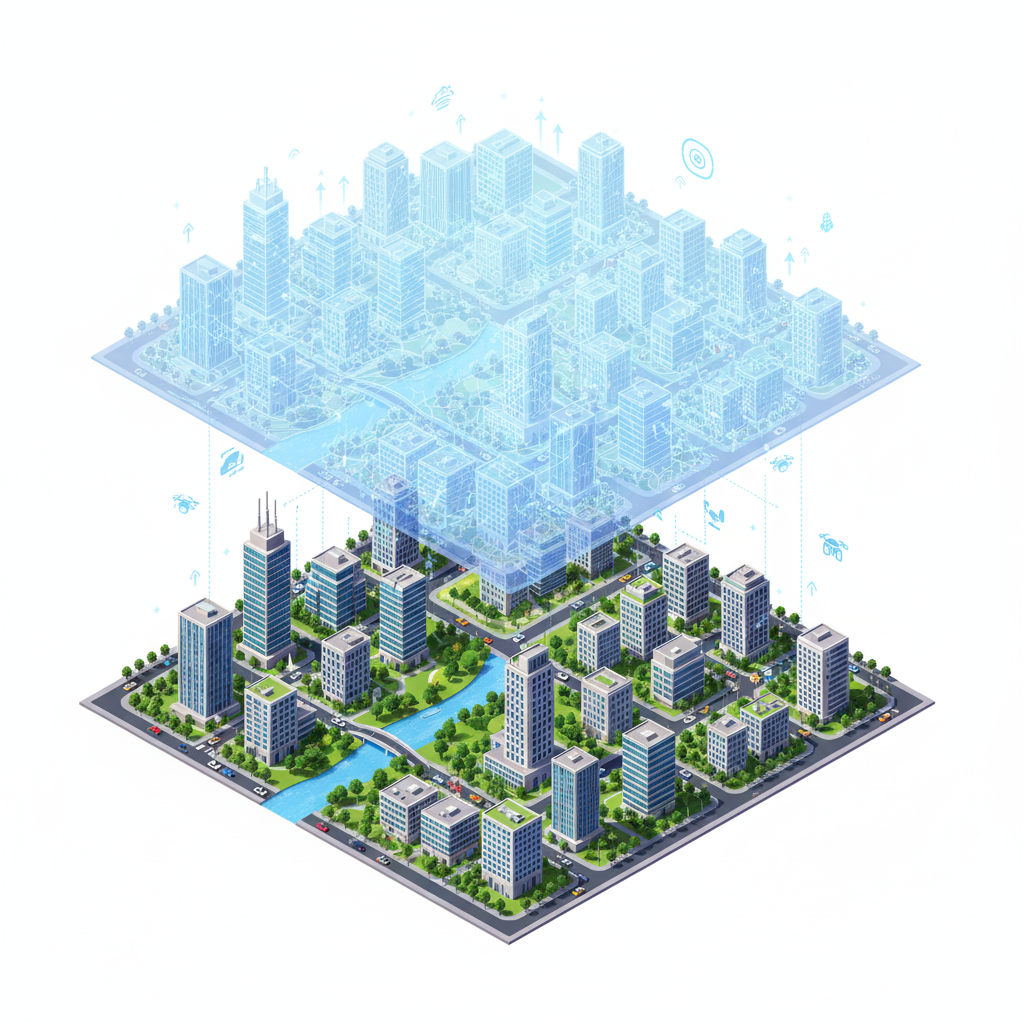
METROPOLIS develops an open, interoperable urban digital twin framework for planning, simulation, and decision support. The project responds to a structural gap: cities increasingly need to evaluate the consequences of major planning decisions before implementation, but the technical infrastructure for doing so reliably does not yet exist at scale.
Urban digital twins can in principle connect spatial data, real-time feeds, historical records, and predictive models into a unified analytical environment. In practice, however, these systems are difficult to build and maintain. Urban data is fragmented across agencies and vendors, stored in incompatible formats, and governed by different institutional standards. AI models require heterogeneous inputs that are rarely available in compatible forms, and cities lack the workflow orchestration and benchmarking tools needed to combine models into coherent planning processes.
METROPOLIS addresses these challenges by contributing specific technical infrastructure: a data interoperability layer, a modular interface for deploying urban AI models, scenario-generation pipelines that orchestrate multiple models, and comparative evaluation benchmarks for assessing model performance across cities and planning contexts. The framework is validated through a pilot deployment with Tel Aviv.
The project’s contribution is infrastructure, not a single model or prediction. By making urban digital twin technology modular, documented, and replicable, METROPOLIS aims to lower the barrier for researchers and municipalities to build on each other’s work and to establish practical standards for urban AI integration.
Papers
2026
Publication
Few-Shot Transfer Learning for Cross-City Pedestrian Level-of-Service Mapping Using Spatio-Temporal Graph Models
2026
Publication
Challenges in the Evaluation of Machine Learning Techniques in Generative Urban Design
2025
Publication
AI-Driven Recommendations for Strategic Urban Renewal
2024
Publication
Towards a Robust Evaluation Framework for Generative Urban Design
2022
Publication