
New Paper: Why Students Don't Use Urban AI


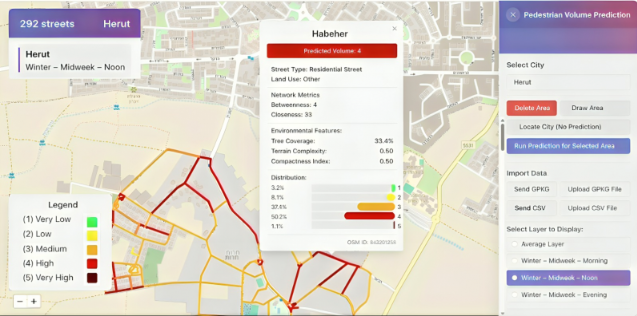
Our paper “Why Students Don’t Use Urban AI: A Study of Machine Learning Tool Adoption in the Design Studio” is now published in the proceedings of the 44th Conference on Education and Research in Computer Aided Architectural Design in Europe (eCAADe 2026), held in Lübeck, 7–11 September 2026 (Damtsas, E. and Spaeth, A. B., eds., Informed Creativity in Architecture and Engineering, Volume 3, pp. 157–166).
The paper, co-authored by Ofir Glassman, Orly Cohen-Moas, Achituv Cohen, Noam Teshuva, and Jonathan Dortheimer, asks a question that sits at the heart of our research: if we build machine learning tools for urban design, do students actually use them?
We examined the conditions that enable or constrain students’ meaningful use of a web-based ML urban analytics tool in a third-year urban design studio. The tool predicted pedestrian volumes as a proxy for walkability and displayed results on a map. Drawing on a usage survey and 12 semi-structured interviews, we found that although students encountered the tool and occasionally tried it, they did not integrate it into their iterative design practice.
This reflected a sociotechnical misfit spanning model validity, explainability, interface design, pedagogical support, and studio time pressures. Four barriers in particular shaped non-adoption:
- Mistrust of opaque outputs — the tool’s predictions often felt implausible and hard to verify
- Translation difficulty — students struggled to convert predictive maps into concrete design decisions
- Unmet expectations for dialogue — students expected an interactive, conversational AI rather than a one-way analytics tool
- Time-benefit misalignment — studio culture and assessment structures made the tool feel too costly to learn mid-project
Making AI tools genuinely useful in design education requires more than technical capability — it demands attention to model transparency, pedagogical scaffolding, and the realities of studio culture and assessment.
Read the full paper: https://papers.cumincad.org/cgi-bin/works/paper/ecaade2026_268