
Can AI "Feel" an Architectural Space?


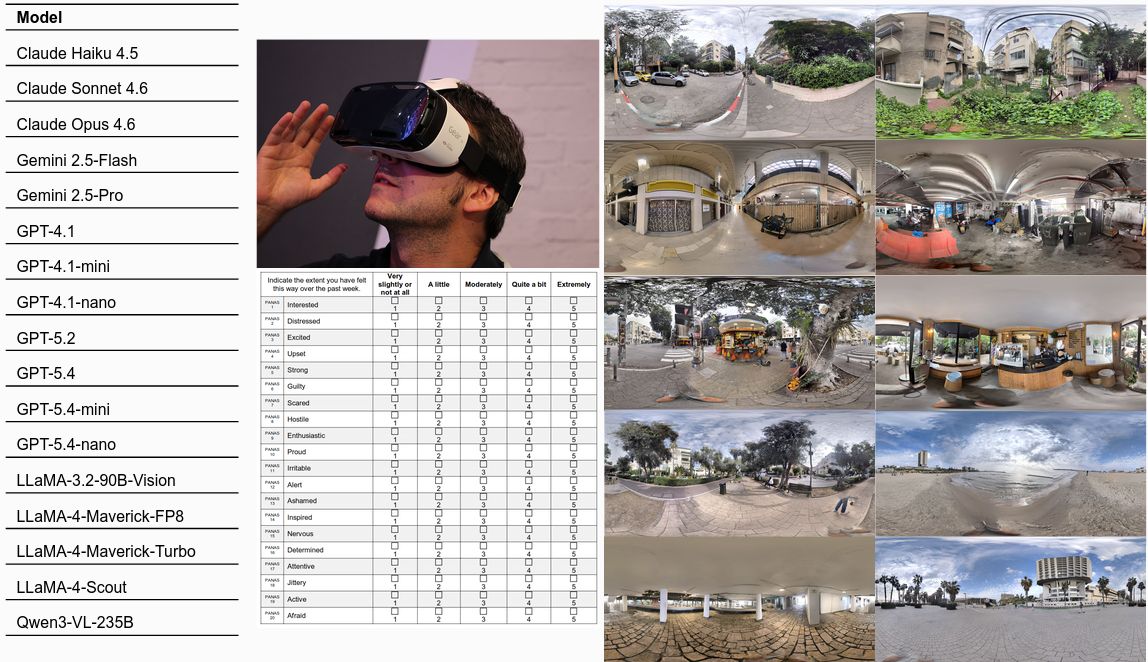
Our new preprint benchmarks 17 Vision-Language Models (VLMs) against a dataset of 1,680 human experiences in Virtual Reality environments to answer a deceptively simple question: can AI reliably predict human spatial emotions?
Using the psychometric Positive and Negative Affect Schedule (PANAS), we uncover three critical insights into how machines evaluate spatial design:
-
AI captures the relational vibe. Top-performing models — including GPT-5.4, GPT-4.1-mini, and Qwen3-VL-235B — mirrored human emotional rankings with high fidelity.
-
The “emotional compression” blind spot. While AI gets relative rankings right, it flattens intensity, particularly for negative affect. Models systematically underestimate real human fear and discomfort, producing their largest errors on threat-related descriptors such as hostile, afraid, and alert.
-
Model performance varies wildly. Not all VLMs are built for human affect. While flagship models preserved the global geometry of human emotion, lighter models — such as Gemini 2.5 Flash and GPT-5.4-nano — failed to generate reliable emotional profiles.
The takeaway: AI is ready to function as an “affective screening tool.” We can now evaluate hundreds of spatial concepts in minutes to optimize for collective human well-being. However, because models consistently mute negative emotional extremes, they still require human eyes in the loop.
Co-authors: Haya Brama, Adiya Nussbaum-Karmon, Gerhard Schubert, Nikolas Martelaro, Ofir Glassman, and Neta Ben-David
Read the paper: https://papers.ssrn.com/sol3/papers.cfm?abstract_id=7359219